

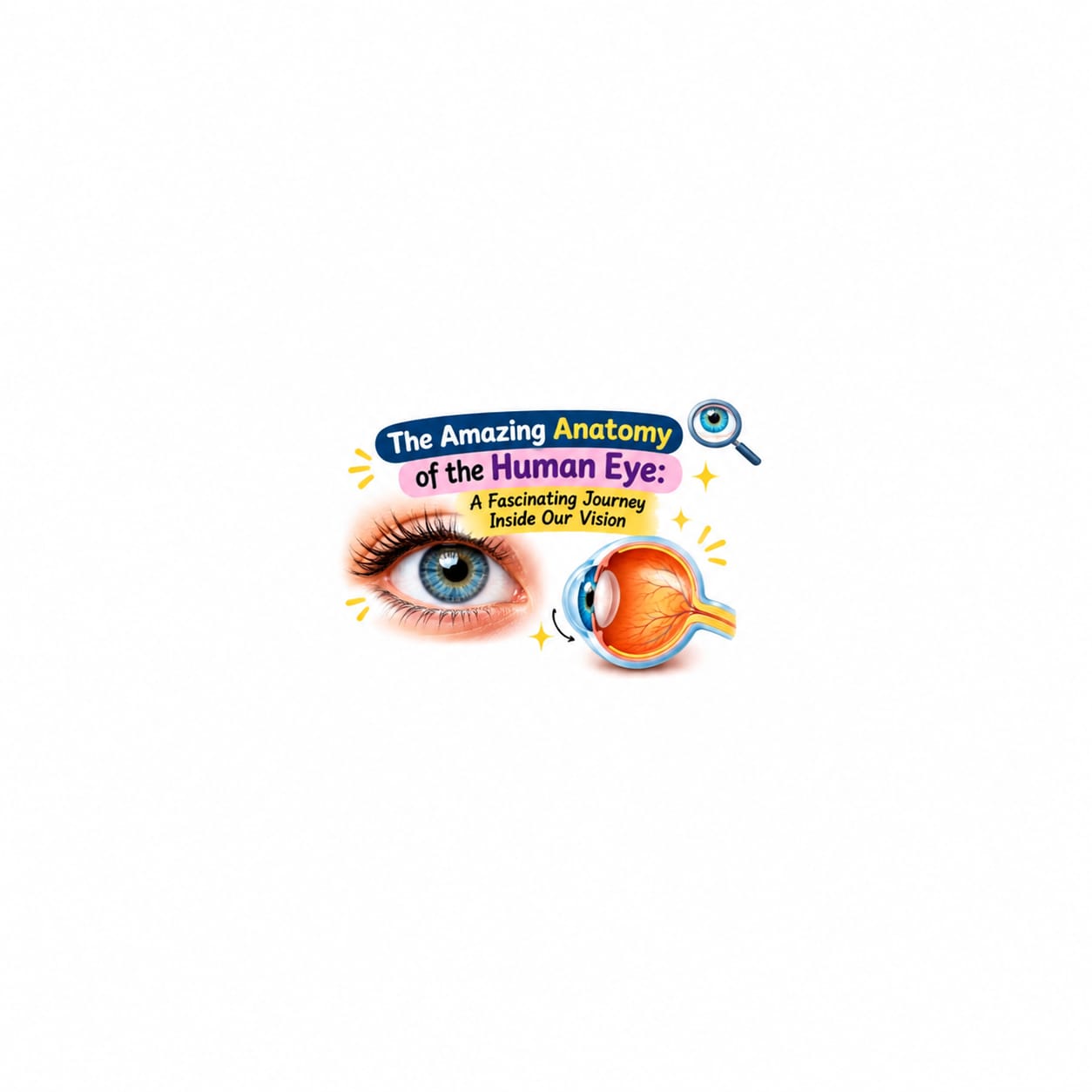
The human eye is one of the most extraordinary organs of the human body. Although it looks small and simple from the outside, its internal structure is incredibly complex. Every second, our eyes work continuously to capture light, process visual information, and help us understand the world around us.
But have you ever wondered what happens inside your eyes when you look at something? How does light enter the eye? What are its three main layers? And how does the brain transform light into the beautiful images we see every day?
Let’s explore the amazing anatomy of the human eye and discover how its different structures work together to make vision possible.
1. The Cornea: The First Gateway of Vision
The journey of vision begins with the cornea, the transparent, dome-shaped outer covering at the front of the eye. It acts as a protective barrier while allowing light to enter.
The cornea also plays an important role in bending and focusing incoming light so that it can reach the retina properly. Even a slight change in its shape can affect the clarity of our vision.
2. The Iris and Pupil: Controlling the Light
Behind the cornea are two important structures: the iris and the pupil.
The iris is the coloured part of the eye, while the pupil is the small dark opening at its centre. The pupil controls how much light enters the eye.
In bright surroundings, the pupil becomes smaller to reduce the amount of incoming light. In darker environments, it expands to allow more light inside.
This automatic adjustment helps our eyes adapt to different lighting conditions.
3. The Lens: Bringing the World into Focus
The lens is a transparent and flexible structure located behind the iris and pupil. Its main responsibility is to focus incoming light onto the retina.
What makes the lens fascinating is its ability to change shape. When we look at nearby objects, it becomes thicker, and when we focus on distant objects, it becomes thinner.
This process is known as accommodation, allowing us to shift our focus between objects at different distances.
4. The Three Main Layers of the Human Eye
One of the most fascinating features of the human eye is its three-layered structure. Each layer has a specific responsibility, and all three work together to protect the eye and support vision.
Outer Layer – Fibrous Layer
The outermost layer consists mainly of the cornea and sclera. The sclera is the tough, white portion that protects the eye and maintains its shape, while the transparent cornea allows light to enter.
Middle Layer – Vascular Layer
The middle layer includes the choroid, ciliary body, and iris. It contains blood vessels that supply essential nutrients and oxygen to the eye. It also helps control the amount of light entering and supports the focusing process.
Inner Layer – Retina
The retina is the innermost, light-sensitive layer of the eye. It contains specialised cells called rods and cones that detect light and help us recognise colours, shapes, and fine details.
It converts incoming light into electrical signals that are transmitted to the brain through the optic nerve.
5. The Retina: Where Light Becomes Visual Information
The retina is one of the most remarkable parts of the human eye. It contains millions of specialised photoreceptor cells that respond to light.
There are two main types of photoreceptor cells:
- Rods: Help us see in low-light conditions and are especially important for night vision.
- Cones: Help us recognise colours and see fine details, particularly in bright light.
Once these cells detect light, they convert visual information into electrical signals that travel towards the brain for processing.
6. The Optic Nerve: Connecting the Eye to the Brain
The optic nerve acts as a communication pathway between the eye and the brain. It carries electrical signals from the retina to the brain, where the information is processed and interpreted.
Interestingly, our eyes do not independently create the complete experience of vision. The brain plays an equally important role by helping us recognise people, understand surroundings, identify colours, and interpret everything we see.
How Does the Human Eye Actually Work?
The entire process of vision happens incredibly quickly, involving several structures working together.
- Light enters the eye through the cornea.
- The pupil controls the amount of light entering.
- The lens focuses the light onto the retina.
- Photoreceptor cells convert light into electrical signals.
- The optic nerve carries these signals to the brain.
- The brain processes the information and allows us to understand what we are seeing.
All these processes happen within fractions of a second, making human vision one of the most extraordinary functions of the body.
Final Thoughts: A Small Organ with an Extraordinary Design
The human eye is much more than an organ that simply helps us see. It is a highly organised biological system where multiple structures and three different layers work together with remarkable precision.
From the transparent cornea to the light-sensitive retina and the optic nerve connecting everything to the brain, every component has an essential role in creating the experience of vision.
Understanding the 3D anatomy of the human eye gives us a fascinating opportunity to explore what normally remains hidden beneath its surface. It reminds us that even the smallest organs in our body can contain some of the most incredible biological designs.
Our eyes do not simply capture the world around us; they work together with our brain to help us experience it.